

In October 2024, Diamond Sports Group told a bankruptcy court it intended to end its relationship with 11 of the 12 MLB teams it televised in 2024, keeping only the Atlanta Braves.
The company had spent the prior year and a half in Chapter 11, and the announcement read as the terminal event for the regional-sports-network model that had funded local baseball broadcasting for three decades.
One company, carrying a dozen teams' games behind a cable paywall, collapsing under debt it could no longer service.
The actual outcome three months later was less clean.
When Diamond Sports emerged from bankruptcy in January 2025 as Main Street Sports Group, with nearly $9 billion in pre-petition debt reduced to $200 million, it had in fact renewed with eight of those teams: the Braves, Royals, Angels, Marlins, Brewers, Cardinals, Tigers and Rays.
The rebrand (the company's 16 regional networks now operate as FanDuel Sports Network) was framed as a stabilization, not a retreat.
It did not hold.
By February 2026, six of those eight renewed teams — the Royals, Marlins, Brewers, Cardinals, Tigers and Rays — had left FanDuel Sports Network anyway, their broadcasts folded into MLB Local Media, the league's own production and distribution arm.
The Braves left for a fully independent, team-built operation, BravesVision, launched in 2026 with no Main Street or MLB Local Media involvement at all.
The Angels terminated their FanDuel agreement in January 2026, one of nine teams the reporting describes as exiting largely to preserve optionality while Main Street's finances remained unstable, and the team subsequently took over its own regional network rather than staying inside anyone else's.
Of the eight teams that looked rescued in January 2025, all eight had left the FanDuel Sports Network structure within thirteen months.
The January 2025 renewals turned out to be a delay, not a resolution.
By that count, MLB Local Media produces broadcasts for 14 teams as of February 2026: the Diamondbacks, Reds, Guardians, Rockies, Tigers, Royals, Marlins, Brewers, Twins, Padres, Mariners, Cardinals, Rays and Nationals.
This is worth stating precisely, because the popular framing of "team-owned DTC channels" collapses a real distinction. Marlins.TV and Nationals.TV, both launched for 2026, are consumer-facing brand names for content that MLB itself produces and distributes. The league runs the cameras, the truck and the rights sale, and the team's name is on the storefront.
BravesVision and Rangers Sports Network are a different thing entirely: broadcast operations built, staffed, and owned by the team, with MLB Local Media nowhere in the production chain.
The distinction matters for everything that follows, because it separates two different bets on what replaces the RSN model: one in which the league becomes the default local broadcaster, and one in which the largest-market or most aggressive teams reclaim full control by exiting the shared system altogether.
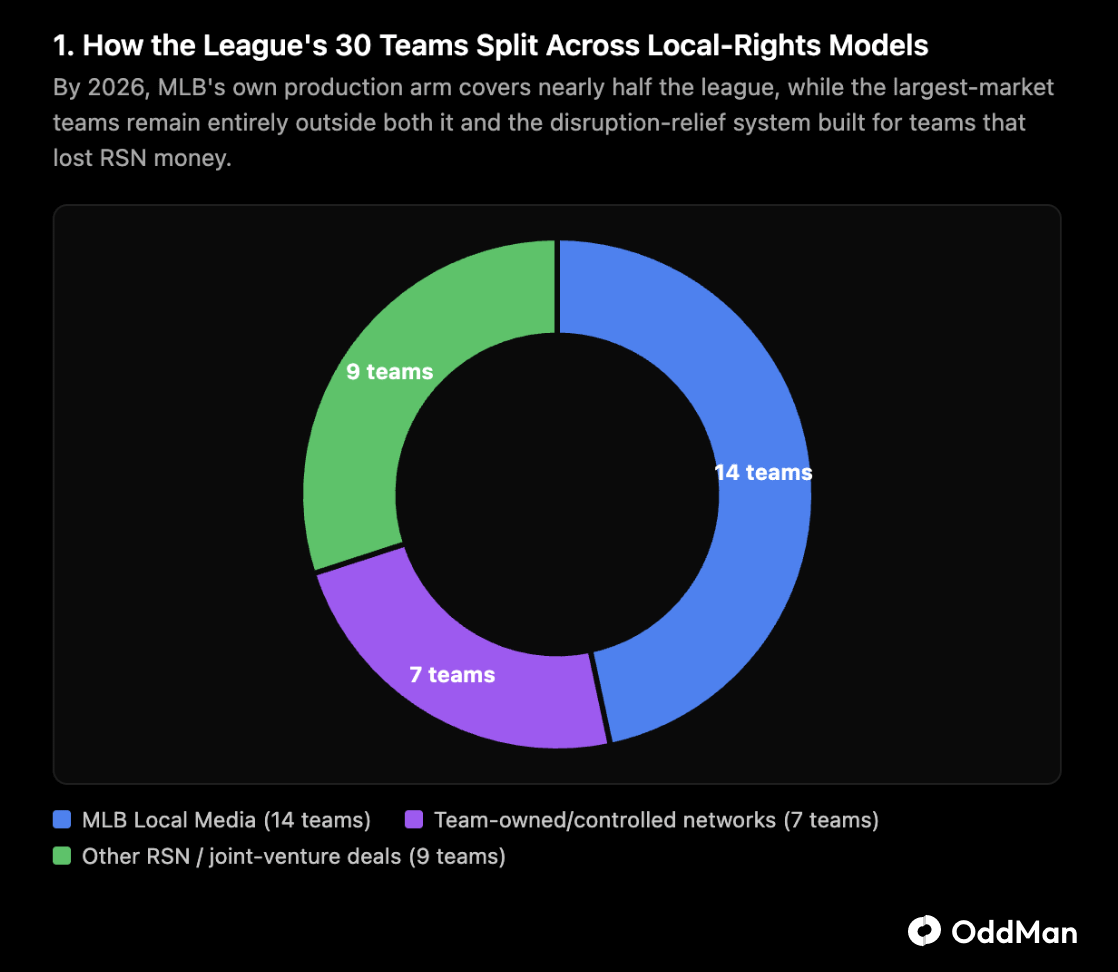
Laid across all 30 teams, the local-rights map by 2026 sorts into three groups:
14 teams under MLB Local Media.
7 teams operating fully team-owned or team-controlled networks (the Dodgers' SportsNet LA, the Yankees' YES Network, the Mets' SNY, the Cubs' Marquee Sports Network, the Rangers' RSN, the Braves' BravesVision, and the Angels' recently reclaimed network).
9 teams still inside other regional-sports-network or joint-venture structures shared with non-MLB properties (the Red Sox with NESN, the Phillies with NBC Sports Philadelphia, the Giants with NBC Sports Bay Area, the Orioles with MASN, the Astros and White Sox and Pirates and A's in ventures shared with NBA or NHL co-tenants, and the Blue Jays inside Rogers' cable systems).
Isolating the revenue effect from reshuffling noise
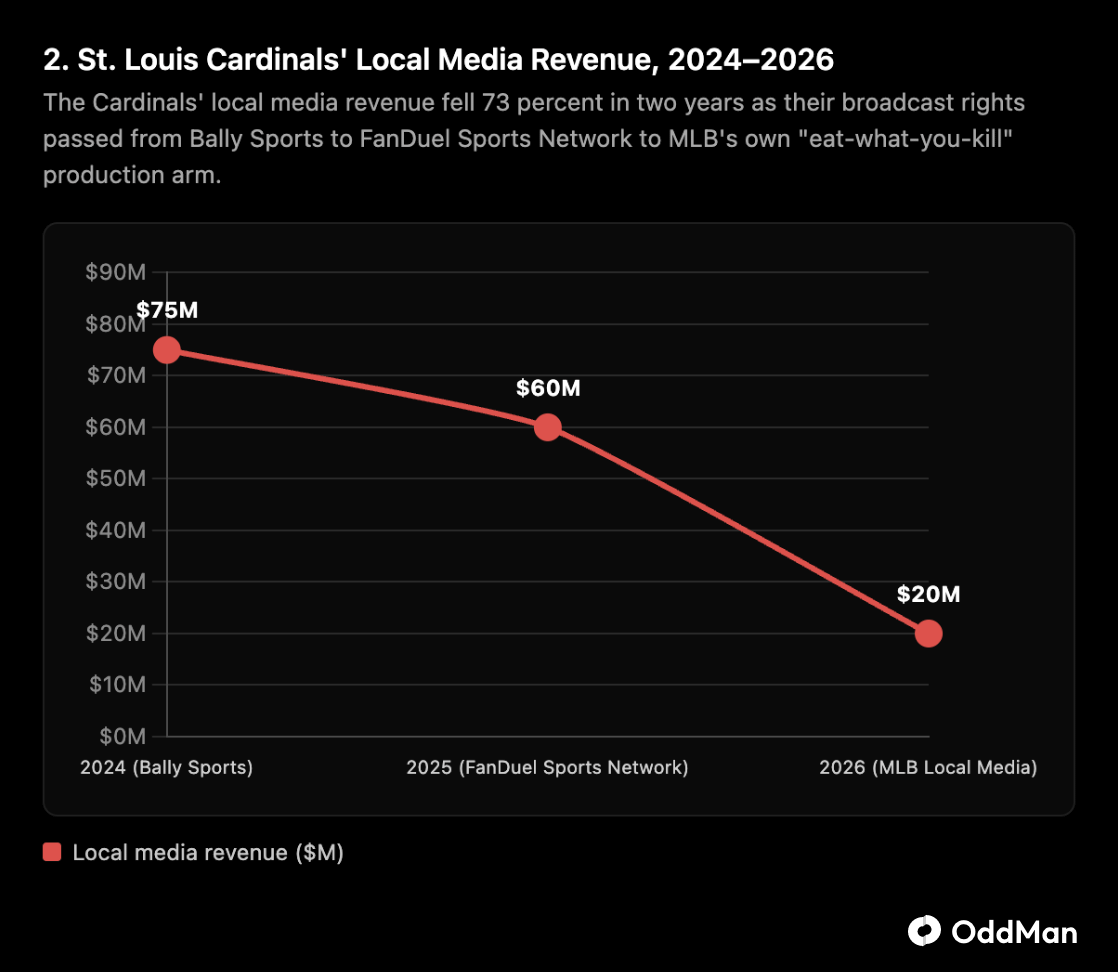
The question of whether this is actually a financial collapse, rather than a change in who signs the check, has one clean case study:
St. Louis Cardinals
The Cardinals local media revenue is documented across three consecutive broadcast structures.
In 2024, the Cardinals received $75 million from Bally Sports.
In 2025, after Bally's restructuring into FanDuel Sports Network, that fell to $60 million.
In 2026, having moved to MLB Local Media, the team's expected revenue is $20 million (a total decline of 73 percent in two years).
The final step is described as an "eat-what-you-kill" arrangement in which the team earns from advertising and carriage fees minus its own production costs, rather than collecting a negotiated rights fee at all.
The Cardinals' trajectory is the sharpest documented case, but the direction is consistent elsewhere.
Texas Rangers
The Texas Rangers were contracted to receive $111 million in 2024 under a 20-year, $3 billion deal signed with Fox Sports Southwest in 2010.
The actual 2024 payment, disputed by the team as overstated even at the lower figure reported, came in at "less than $100 million," a shortfall of at least $11 million against the original contract before the team left for its own network entirely.
Pittsburgh Pirates
The Pittsburgh Pirates' 2022 RSN fee, at $61 million against a $61.2 million payroll, illustrates how thin the margin already was for smaller-market teams even before the bankruptcy. Meaning a fee drawn from a broadcast reaching roughly 28,000 households, or about $2,179 in rights cost per household reached.
None of this is uniform loss, however, and treating it as such would overstate the case.
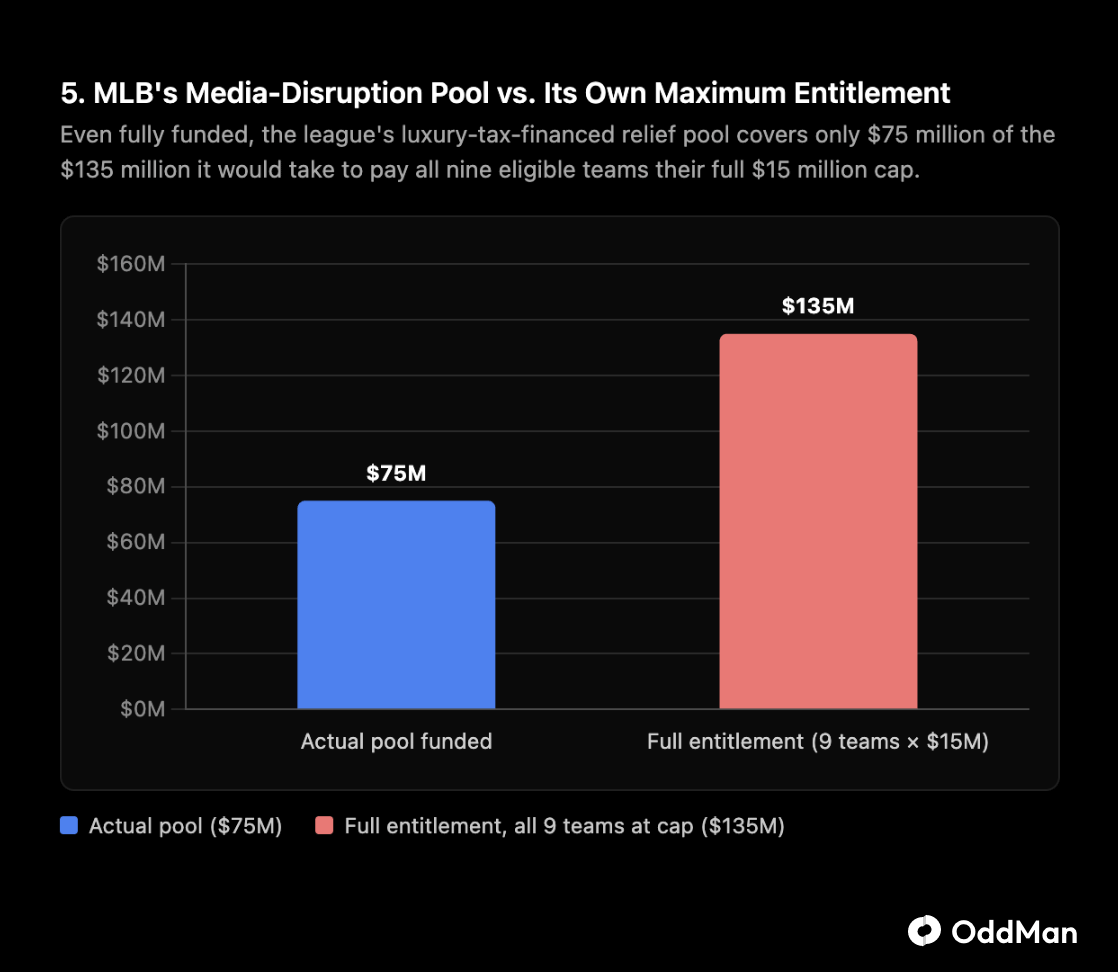
MLB and the players' union built a $75 million "media-disruption distribution" pool, funded from luxury-tax collections, to partially offset the transition for nine teams whose local rights fees fell between 2022 and 2024. Those teams being the Diamondbacks, Guardians, Rockies, Astros, Pirates, Padres, Mariners, Twins and Rangers, each eligible for up to $15 million.
Even at full disbursement to all nine, the pool would fall $60 million short of fully replacing the $135 million in maximum entitlements it was built to distribute, and commissioner Rob Manfred has said the program is not currently scheduled to repeat.
The pool is real, sourced from real luxury-tax money, and it is also explicitly a bridge rather than a replacement. MLB itself has been candid about that.
What's actually rebuilding the model
The RSN collapse did not leave a vacuum.
It coincided with, and helped justify, a restructuring of MLB's national television package that shifted meaningfully more revenue into the centrally-shared pool the league controls directly.
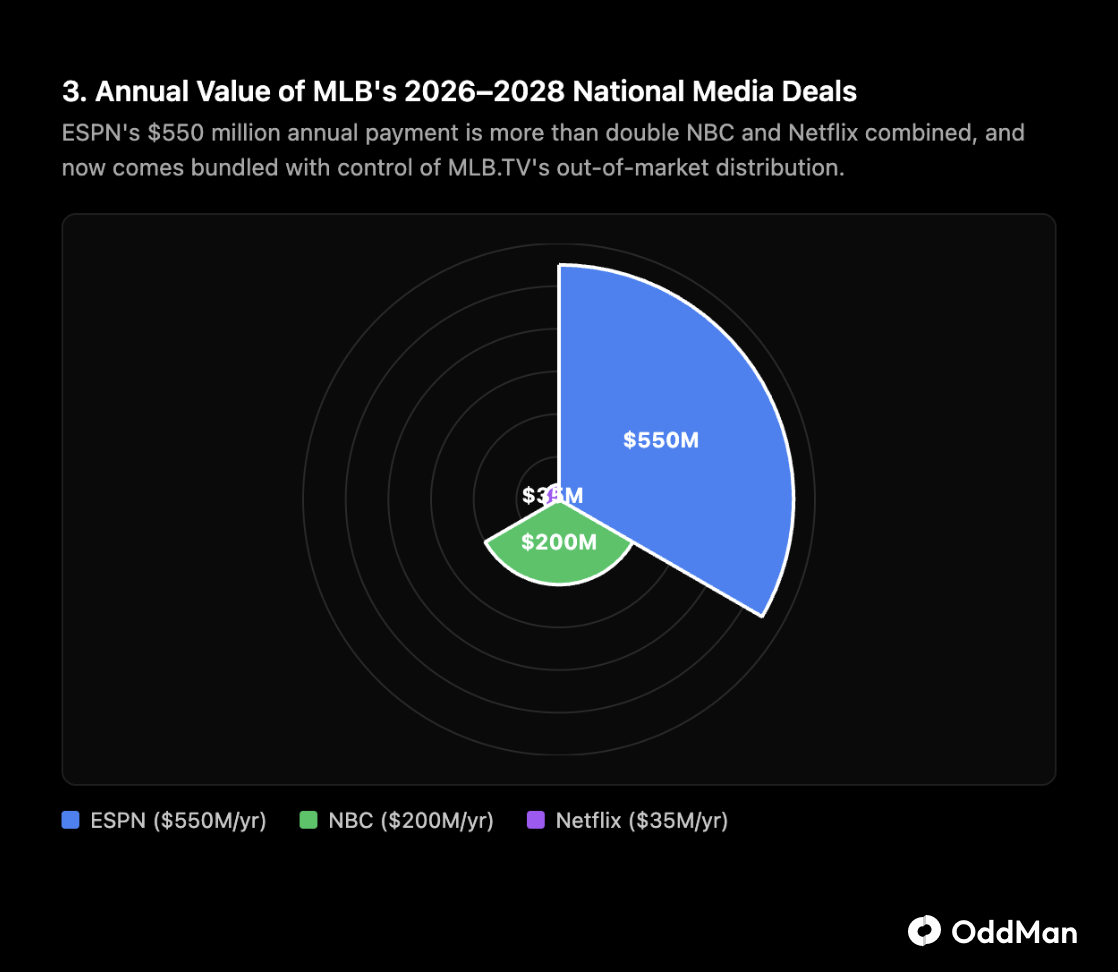
In November 2025, MLB signed three-year deals for 2026 through 2028 with ESPN, NBC, and Netflix.
ESPN retained its existing $550 million annual value for 30 nationally televised games per year, but lost Sunday Night Baseball to NBC and gained something structurally more significant: oversight of MLB.TV and out-of-market distribution rights, a business the league had run mostly on its own.
NBC returned to regular MLB coverage for the first time in 25 years at nearly $200 million annually, covering Sunday Night Baseball, the Wild Card round, and select Peacock-exclusive games.
Netflix, new to the sport, pays roughly $35 million a year for the Home Run Derby, the Field of Dreams game, and a standalone Yankees-Giants Opening Day broadcast.
The practical result is that ESPN, as of the 2026 season, sells the out-of-market MLB.TV subscription directly: $134.99 a season for existing ESPN Unlimited subscribers, $149.99 for new subscribers with a bundled free month.
That folds a previously separate league-run product into a national media company's subscription funnel.
That single move does more to centralize the sport's broadcast architecture than any single RSN's bankruptcy did on its own: it takes the one piece of MLB's media business that was inherently national already (any fan, anywhere, paying for out-of-market access) and hands its retail relationship to the same company paying the league $550 million a year for in-market national windows.
This is the mechanism worth naming plainly.
The RSN collapse forced roughly half the league's local broadcasts into a single, MLB-run production pipeline. The 2025 national-rights renegotiation simultaneously moved MLB.TV, the league's own direct-to-consumer product, under a national partner's commercial umbrella.
Two years ago, "national" and "local" were separate businesses with separate money. By 2026, MLB Local Media, MLB.TV, and the national broadcast package are converging into a single centrally-operated distribution stack.
That is not because the league announced a centralization plan, but because the RSN failures left it holding the local business by default at the same moment it renegotiated the national one.
The persistence of big-market advantage complicates the centralization story
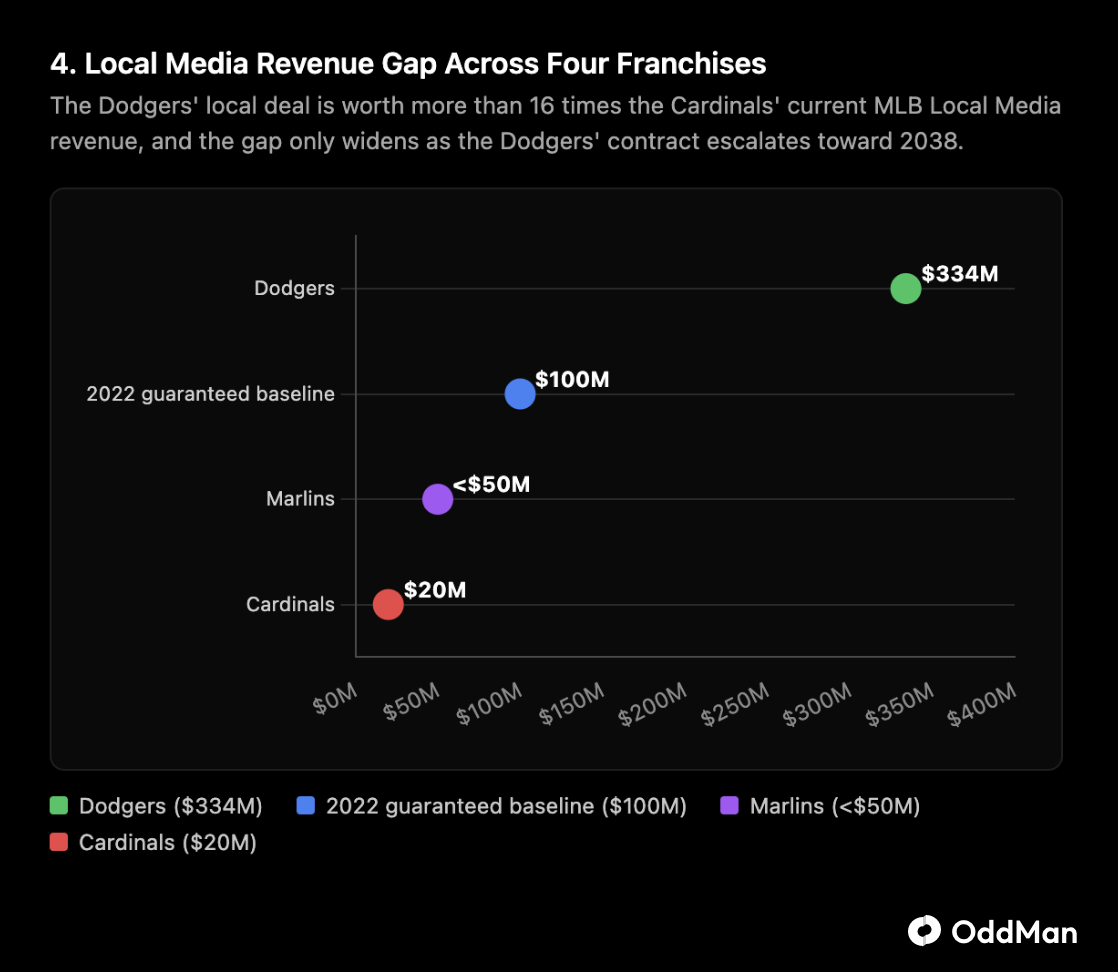
If the RSN model were simply dying everywhere, the case for the league absorbing local broadcasting would be straightforward. It is not dying everywhere, and the exception is instructive.
The Los Angeles Dodgers' local television deal with Spectrum SportsCenter LA, signed in 2013 for 25 years, still averages $334 million a year and is contracted to exceed $500 million annually by its 2038 expiration.
That single team's annual local media revenue is more than four times the size of the entire $75 million disruption pool built to help nine other franchises.
The Dodgers deal also carries a structural advantage unrelated to its size.
Following the team's 2011 bankruptcy, MLB agreed to continue taxing the Dodgers' local revenue for luxury-tax and revenue-sharing purposes as though the team were still under bankruptcy-era valuation, even after the network contract was renegotiated in 2013 on far more lucrative terms.
The exact dollar value of that exemption isn't cleanly disclosed in public reporting. No year-by-year comparison between the Spectrum contract's actual value and the "fair market value" used for revenue-sharing purposes has been published.
Still, the existence of a bankruptcy-court-derived carveout, still in effect more than a decade later, means the league's largest local media contract is also its most sheltered from the revenue-sharing system that other teams' RSN losses are currently straining.
Compare that to the Miami Marlins, whose annual local broadcast revenue sits below $50 million even before their 2026 move to MLB Local Media's eat-what-you-kill structure. The Yankees, whose YES Network revenue, while substantial, runs at less than half the Dodgers' figure despite comparable market size and team value.
The RSN collapse has not touched the Dodgers, Yankees, Mets, or Cubs at all; all four still run their own team-controlled networks outside both MLB Local Media and the disruption-payment system built for teams that lost RSN money.
The teams absorbing the collapse and the teams shielded from it are not randomly distributed.
They track market size and, in the Dodgers' case, a specific piece of decade-old bankruptcy litigation that has nothing to do with the current RSN failures at all.
What the case establishes about the CBA negotiations
The RSN collapse and MLB's collective bargaining position are not two separate stories running in parallel.
They are the same argument made twice.
On May 28, 2026, MLB submitted a formal economic proposal to the players' union that would, for the first time, classify all local media revenue as centralized revenue shared equally among all 30 teams.
That would include not just the roughly half the league already routed through MLB Local Media by circumstance, but the Dodgers' $334 million and the Yankees' YES Network money as well.
The same proposal paired that centralization with a hard salary cap, calling for a 2027 payroll ceiling of $245.3 million and a floor of $171.2 million, and a 50-50 split of revenue growth between players and owners going forward.
Commissioner Rob Manfred has been explicit about why centralized revenue is the point, not a side effect.
He has argued publicly that NBA franchises sell for 10 to 15 times annual revenue while MLB teams sell for 4 to 11 times, and attributes part of that valuation gap to the NBA's heavier reliance on predictable, centrally-distributed national money over volatile local rights deals.
That argument lines up with a disparity reporting on the CBA fight has quantified directly: roughly 26 percent of MLB's total revenue currently comes from national sources, against about 66 percent for the NFL.
Under that framing, the RSN collapse is not a crisis MLB is managing so much as a preview of the outcome it is negotiating for: a league where the Dodgers' local check and the Marlins' local check both disappear into the same centrally-managed pool.
The players' union's counterproposal took a different route to a similar-sounding goal.
Rather than centralizing local revenue, it called for expanded revenue sharing that would guarantee every small-market team a minimum of $240 million in total revenue annually.
That is a redistribution mechanism layered on top of the existing team-by-team ownership structure, not a replacement for it.
The difference is not cosmetic.
Centralization changes who owns the local media asset; a revenue-sharing floor leaves ownership in place and taxes the proceeds.
One is the structure MLB Local Media has already imposed, by necessity, on the fourteen teams the RSN bankruptcies orphaned. The other is closer to the deal the Cardinals or Rangers might have preferred to the one they actually got.
What the last two seasons establish is narrower than either side's rhetoric suggests.
They establish that the RSN local-monopoly model is now structurally dead for a specific tier of the league, roughly the bottom half by market size, and that MLB's own production arm has become the default successor for that tier by circumstance rather than by a deliberate buildout.
They establish that the league's national broadcast renegotiation and its absorption of local production are converging into a single distribution stack faster than either was moving on its own.
They do not establish that full centralization would equalize outcomes.
The Dodgers' bankruptcy-era revenue-sharing exemption shows that even inside a system built around shared and centralized money, the largest markets have historically kept mechanisms to protect their advantage, and nothing in MLB's current proposal explains how a $334 million Dodgers local contract and a since-orphaned $20 million Cardinals contract would be reconciled into one equal share without a fight over whose number becomes the baseline.
Nor do the DTC and MLB Local Media experiments so far establish that the new model even replaces the old one's revenue.
The Cardinals' 73 percent decline and the Rangers' minimum $11 million shortfall are the clearest available data points, and both point toward the transition costing teams money, not neutrally reallocating it.
The RSN model's collapse is real and largely finished.
What replaces it, and who it will actually pay, remains the subject of a labor negotiation that has not yet been resolved.
OddMan exists for exactly this kind of work: a research partner for anyone studying the business and science of sports seriously, not just following headlines. Join us to get the same data and analysis layer used to build this piece, so the next question you have about a franchise’s finances, a rule change, or a roster decision doesn’t have to stop where the article does.