
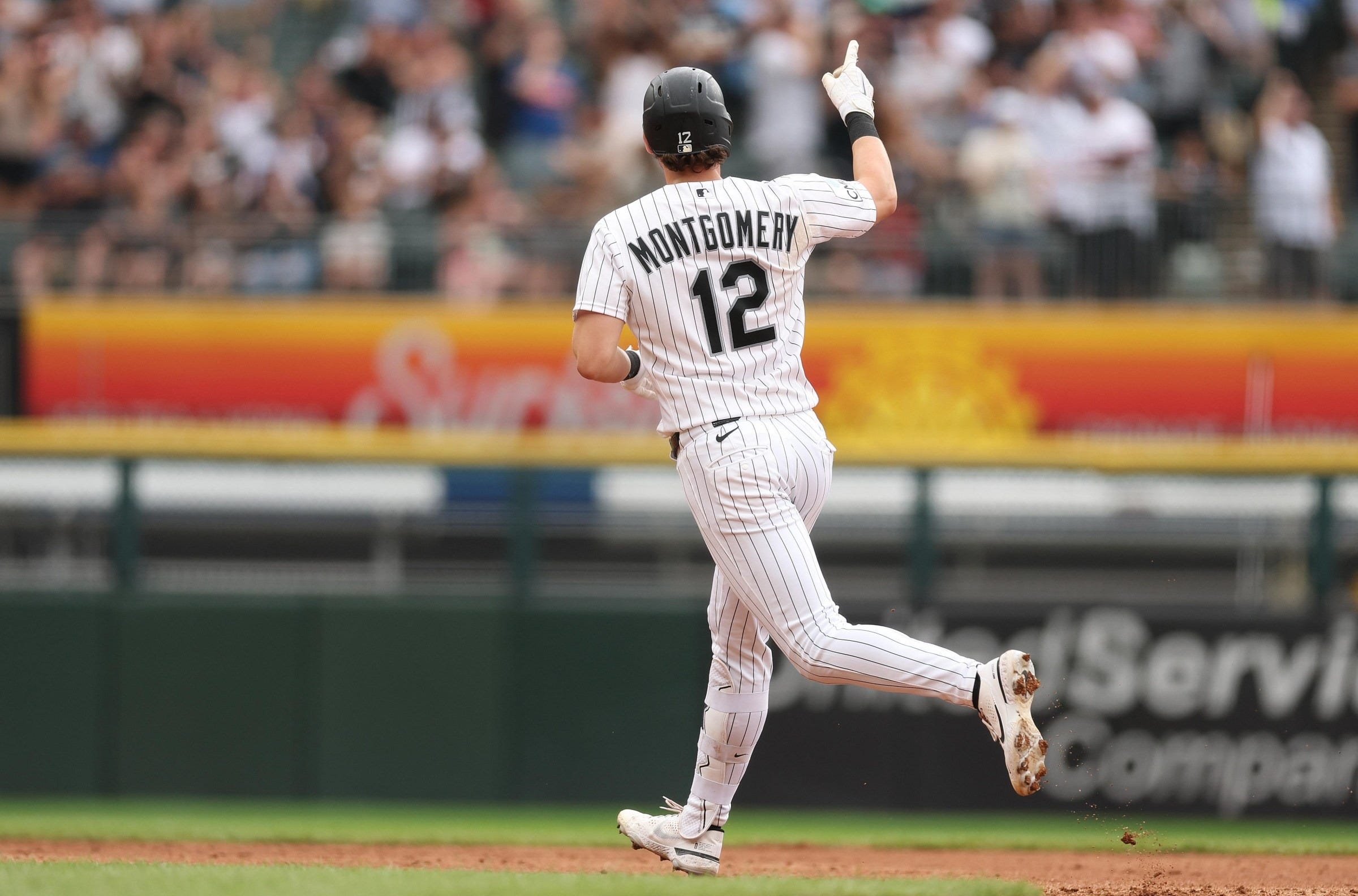
With roughly three weeks remaining in the 2026 season (at the time of this writing), the Chicago White Sox hold sole possession of first place in the American League Central.
They lead by three games over a Cleveland Guardians team that is good enough to simultaneously lead the league's wild-card race.
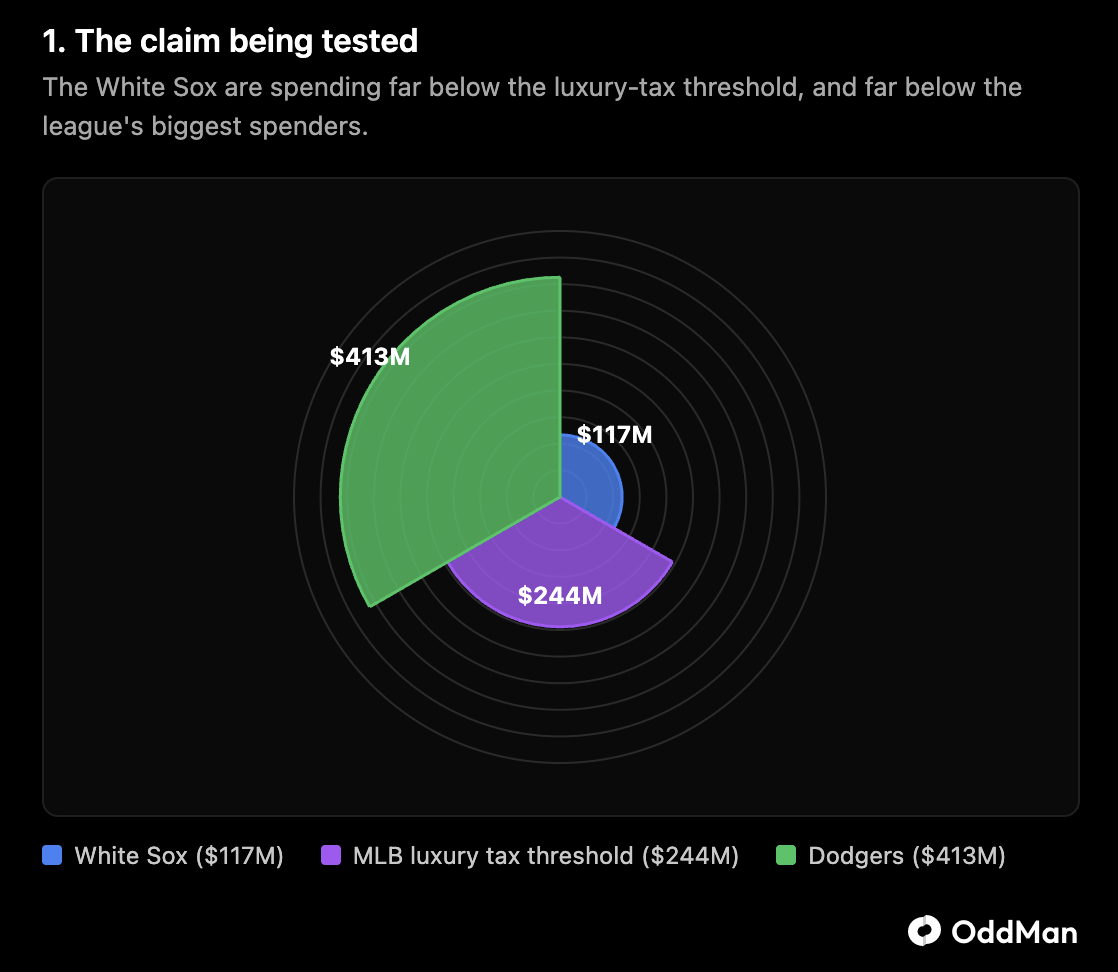
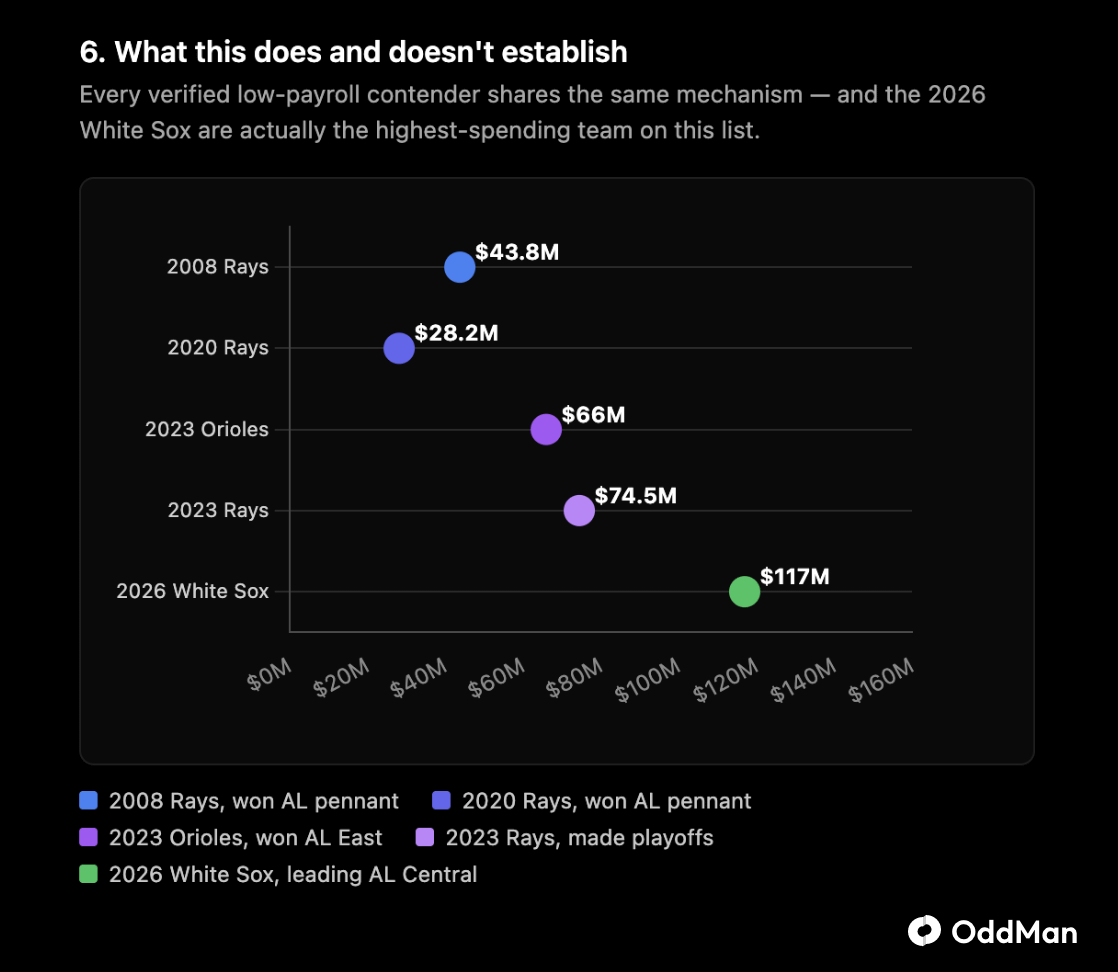
They have reached this position while carrying a payroll of between $105 million and $117 million over the course of the season, depending on the measurement date, which places them 26th to 28th of 30 teams against a $244 million luxury-tax threshold.
That combination is useful for a specific analytical reason, not merely as a late-season curiosity.
Major League Baseball's ownership group is currently proposing a hard salary cap for the next collective bargaining agreement, and the argument for it rests on the claim that payroll disparity is the primary driver of competitive imbalance across the league.
A bottom-payroll division leader, in the same season that argument is being advanced publicly, functions as a natural test case for the claim.
This article treats it as one: it asks what the White Sox's performance data actually shows, what mechanism produced the result, and how far the case can reasonably be generalized.
The argument under examination
MLB ownership's core argument for a proposed hard salary cap in the next CBA is that payroll disparity is the primary driver of competitive imbalance across the league.
The proposal reported publicly pairs a hard cap near $245 million with a payroll floor in the $171 million to $222 million range, alongside a shift toward centralized local revenue sharing.
The MLB Players Association has rejected a cap in any form and countered with a different mechanism: a guaranteed local-revenue floor for smaller-market clubs, funded through expanded revenue sharing, with no ceiling imposed on the high end.
The two sides are not proposing variations on the same fix; they are proposing different diagnoses of what actually causes competitive imbalance, which is what makes a real-time counter-example like the White Sox analytically useful rather than incidental.
The 2026 White Sox are a useful test case for the owners' specific claim in something close to real time.
They are a franchise spending between $105 million and $117 million on payroll this season, depending on the point in the year measured. They are ranking 26th to 28th of 30 teams against a $244 million luxury-tax threshold and are presently the best team in their division.
It is worth being precise that this is a payroll position, not a valuation position: independent 2026 rankings from Forbes and CNBC place the White Sox 17th to 20th of 30 teams by enterprise value, well clear of the league's five lowest-valued franchises (Miami, Kansas City, Cincinnati, Pittsburgh, and Minnesota).
Chicago's low payroll is a front-office choice made during a rebuild by a mid-value franchise, not evidence that a structurally low-revenue team can compete on parity terms with the sport's largest markets, and the two claims support different conclusions about the underlying parity question.
Naturally, this leads us to three questions.
Is the White Sox's record supported by underlying performance, or is it a product of favorable variance likely to regress before the season ends?
What roster-construction mechanism explains the result, and is that mechanism specific to this team or observed elsewhere historically?
What does this case actually establish about the broader parity debate, and what does it not establish?
Isolating variance from underlying performance
The standard diagnostic for distinguishing a "deserved" record from a fortunate one is the gap between actual wins and Pythagorean expected wins, a function of run differential.
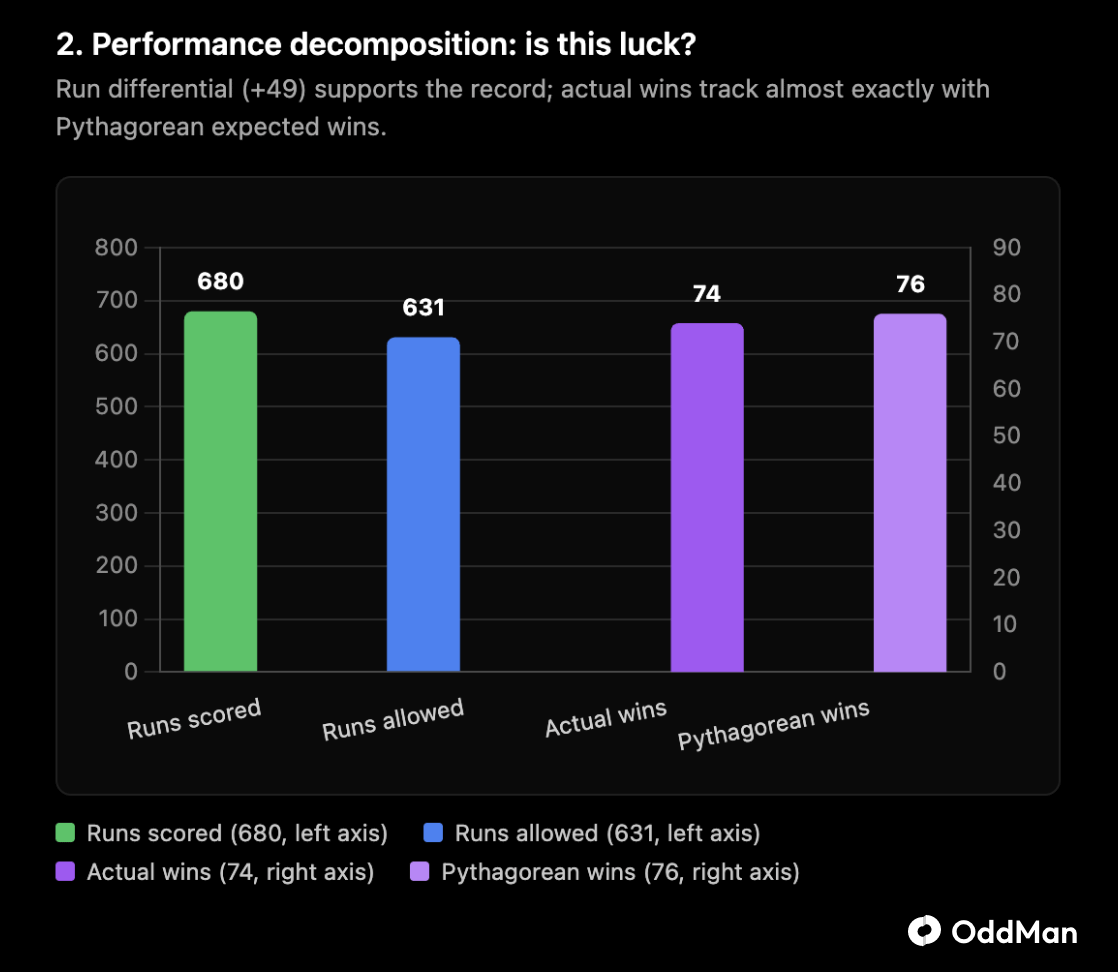
Chicago has scored 680 runs against 631 allowed this season, a +49 run differential that produces a Pythagorean expected record of 76-67.
Their actual record over the same span sits at 74-68, meaning the team is performing in line with, and if anything marginally below, what its underlying run production and prevention would predict.
A team benefiting from favorable sequencing — winning an outsized share of one-run games — typically shows the opposite pattern, with actual wins outpacing what run differential would predict.
That is not the pattern observed here.
The month-by-month data reinforces this rather than complicating it.
In August specifically, an overtaxed bullpen produced a losing Pythagorean split for that month alone (133 runs scored against 140 allowed), and the team's actual results tracked that decline rather than defying it.
A club riding sequencing luck would be expected to paper over exactly this kind of underlying dip; this one did not.
This matters because it forecloses the simplest dismissal of the case. If the White Sox were merely accumulating fortunate results in close games, the appropriate response would be to expect regression and set the case aside.
The data instead indicates a team whose run production and prevention are genuinely competitive across the full season and consistent at the monthly level, which is a materially different, and more consequential, finding for the question at hand.
What’s actually producing the result
The roster construction underlying this result is specific and identifiable, not diffuse.
A cluster of position players in their mid-20s or younger — Colson Montgomery, Kyle Teel, Chase Meidroth, Braden Montgomery, Sam Antonacci, and Miguel Vargas — account for the bulk of the team's value while earning pre-arbitration or first-arbitration-year salaries, a small fraction of open-market cost for comparable production.
The individual performance underlying that value is not marginal.
Colson Montgomery, in his first extended major-league look, slashed .239/.311/.529 with 21 home runs and an .840 OPS across 71 games.
Teel and Meidroth both posted numbers atop the team's rookie leaderboard the year before this core was handed the everyday roster: Teel hit .273 with a .786 OPS, and Meidroth hit .253, the two highest batting averages on the team alongside fellow rookie Edgar Quero.
This is production at or above league-average offensive output, generated by players whose salaries are set by service-time rules rather than by what that production would command on the open market.
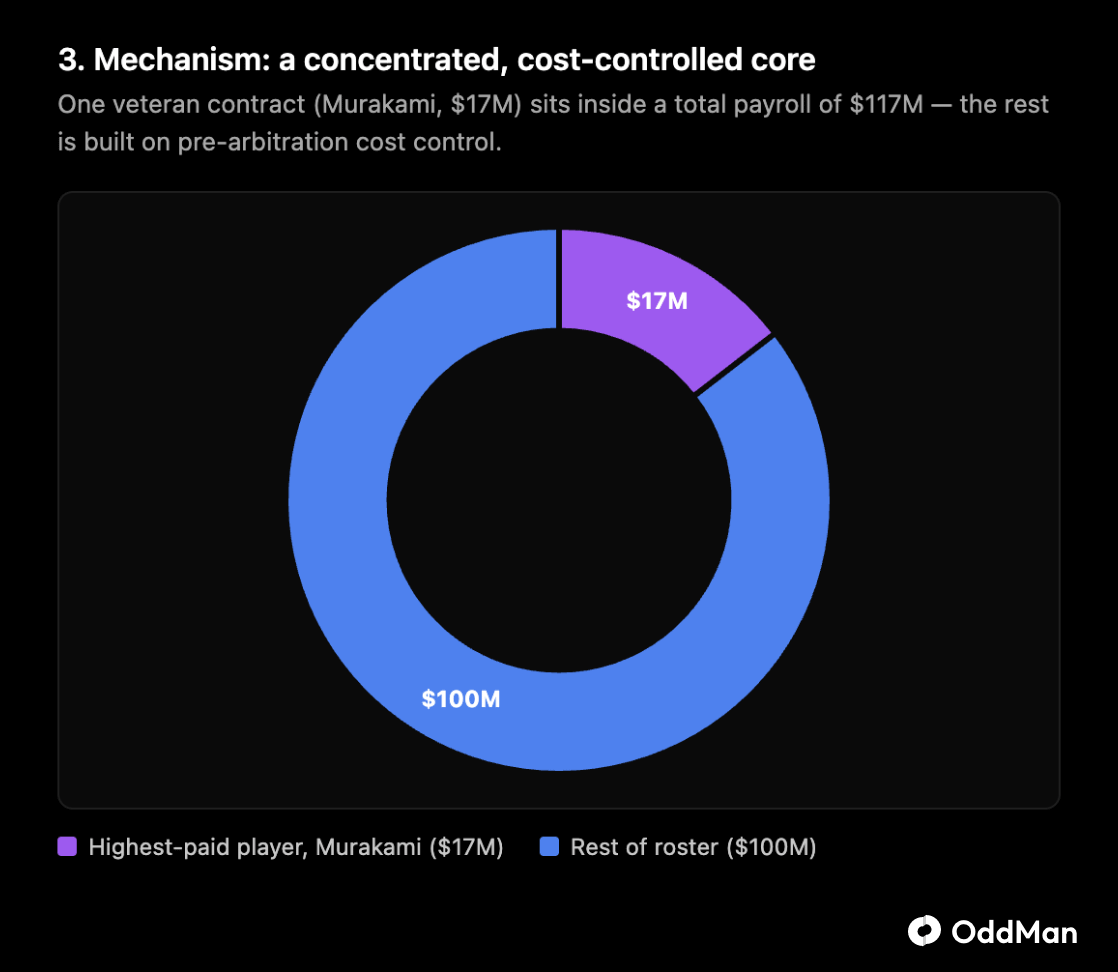
Around this core, the organization made one notable financial commitment: a two-year, $36 million contract for Munetaka Murakami, whose $17 million 2026 salary makes him the highest-paid player on the roster by a wide margin over anyone in the pre-arbitration group.
Beyond that single addition, the front office otherwise avoided adding salary at the trade deadline, reportedly declining to include core young players, Montgomery specifically among them, in trades for short-term rental pitching help.
The roster is, in effect, one veteran bet layered on top of a cost-controlled core, rather than a broadly reshuffled 26-man group.
This is a known, previously observed mechanism rather than a novel one, and the historical cases share more than a payroll bracket.
Let’s examine a few of those cases.
The 2008 Tampa Bay Rays carried a $43.8 million payroll, second-lowest in the league, were described at the time as one of the youngest rosters in baseball, and won the American League pennant.
The 2020 Rays, at roughly $28.2 million and third-lowest in the sport, relied on a roster in which several regulars had not yet accrued enough service time to qualify for arbitration, and also reached the World Series.
The 2023 Baltimore Orioles, second-lowest payroll in MLB that year, were built around a young core fronted by catcher Adley Rutschman and finished 101-61 to win the AL East.
The 2023 Rays, 28th of 30 in payroll at $74.5 million with Zach Eflin as their highest-paid player at $11 million, opened that season 13-0, the best start in modern major-league history, before making the playoffs as a Wild Card.
Across every verified comparable case, the mechanism is the same: a talent-development and roster-timing advantage exploited during a specific team-control window, not a generally efficient approach to twenty-six-man roster construction.
This franchise has run this play before
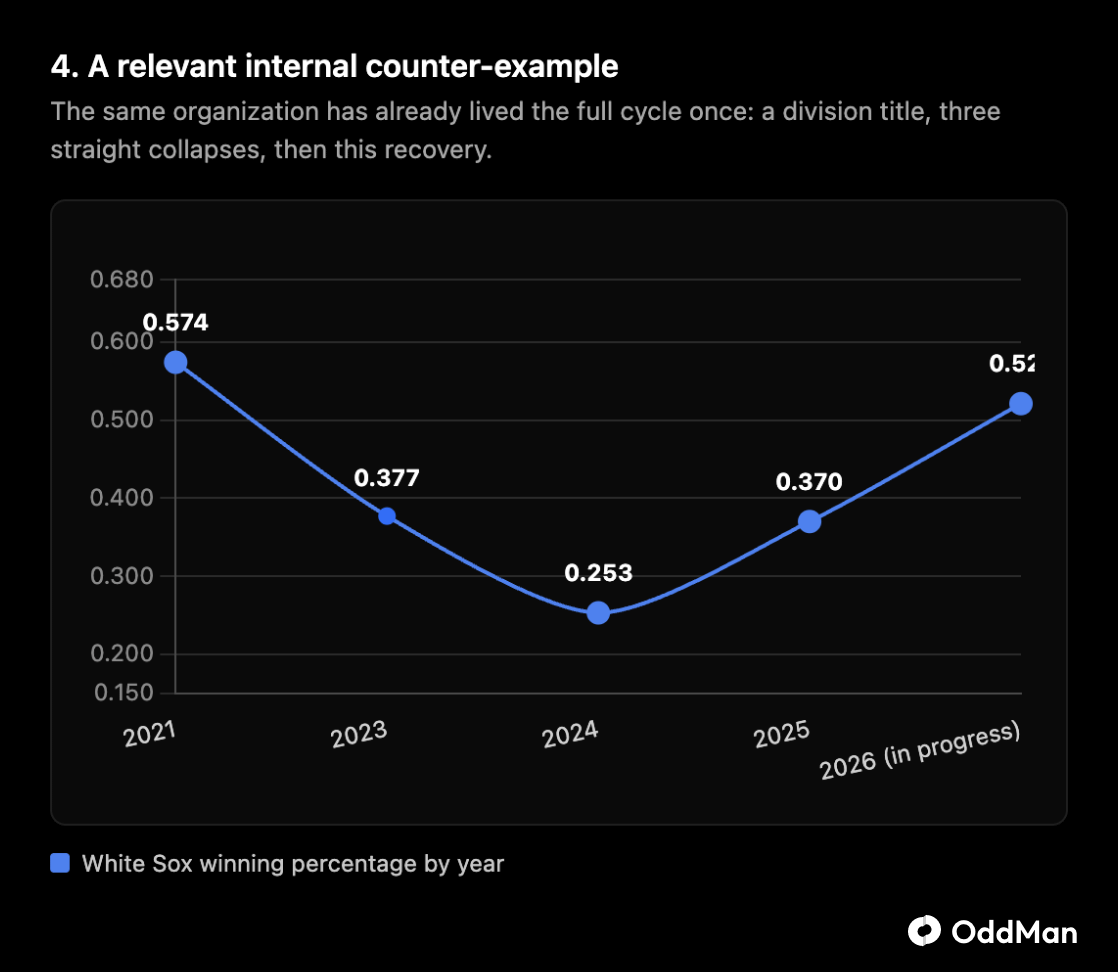
The same organization provides its own caution against generalizing from this case. The White Sox's previous rebuild, built around Yoan Moncada, Eloy Jiménez, and Luis Robert Jr., followed a structurally similar template: a young, cost-controlled core given a runway to develop. That version of the strategy failed.
Development stalled, the organization extended several of those players to long-term contracts before they had established major-league performance, and the outcome was a three-season stretch that included the worst full single season in modern MLB history.
The mechanism observed in 2026 is not new to this front office; its prior application, under similar starting conditions, produced the opposite result.
That version of the strategy failed, and it failed specifically along the pre-established-performance dimension:
Jiménez, whose rookie year had shown real power (31 home runs, a .513 slugging percentage), spent most of the rest of his Sox tenure battling recurring soft-tissue injuries. By 2024 he was hitting .231 in an injury-shortened season before Chicago traded him to Baltimore on July 30, 2024 for a single minor-league reliever, a return that reflected how little was left of the original investment.
Moncada's decline followed a similar arc, and the White Sox declined his 2025 club option rather than pay a $25 million salary for a diminished everyday role.
Robert Jr., the one player from that core still with the organization by 2025, was also the one whose bet looked the most justified in year one but whose production had become inconsistent enough by the time of the rebuild's end that he no longer resembled the foundational piece the extension had envisioned.
The outcome across the group, compounded by the broader roster's decline around them, was the 2023-2025 stretch of three consecutive 100-loss seasons, anchored by the 41-121 mark in 2024 that stands as the most losses by a team in a full modern-era season.
This is evidence that the strategy's success rate, even within a single organization working with players it evaluated and developed itself, is not high, and that execution and player-development and health variance are doing at least as much work as the strategic template itself.
It also suggests a live risk specific to the current core.
The 2026 roster has so far avoided the extend-before-you-know-what-you-have step that defined the Jiménez and Robert deals.
How the organization handles that decision with Montgomery, Teel, and the others as they approach arbitration will be a more direct test of whether the lesson from 2019-2020 was actually learned.
The limits of what this case proves
The 2026 White Sox constitute genuine, verifiable evidence against the strongest version of the owners' claim: that a bottom-quartile payroll forecloses contention.
The team's performance is supported by underlying run production, not variance, and the roster-construction mechanism producing it is well-documented and consistent with prior successful cases elsewhere in the league's recent history.
The case does not establish that payroll disparity is immaterial to competitive balance more broadly, for two reasons.
First, the mechanism observed is narrow and time-limited by construction: cost-controlled cores become expensive as players approach arbitration and free agency, and the same organization's history demonstrates that the transition from "developing core" to "sustained contender" is not reliable, even internally.
Second, Chicago's mid-tier valuation means this is not a test of whether the league's most revenue-constrained franchises specifically can compete without structural assistance. It is a test of whether a mid-value franchise choosing a lean payroll during a development window can compete, which is a narrower and less consequential claim.
The appropriate scope for this finding is accordingly limited.
It is a valid counter-example to categorical claims that spending is a precondition for contention, and it is not evidence bearing on the sustainability of low-payroll competitiveness across the broader set of franchises the collective bargaining negotiation is actually concerned with.
Whether the current White Sox core converts this window into sustained contention, or follows the trajectory of the organization's previous attempt at the same strategy, will not be determinable from the data available at this point in the season.
OddMan exists for exactly this kind of work: a research partner for anyone studying the business and science of sports seriously, not just following headlines. Join us to get the same data and analysis layer used to build this piece, so the next question you have about a franchise's finances, a rule change, or a roster decision doesn't have to stop where the article does.